** As you will notice, There is no longer pricing for these on this website, Information only, Please visit https://ragweedforgestore.com/collections/allan For Purchases and New models**
I get a lot of inquiries on how to select a throwing ‘hawk, so here's a quick primer for those new to the sport. First, don't take these suggestions too seriously. Almost any axe can be thrown, and if you have a strong preference for a style that does not fit these recommendations you can probably make it work.
The key to sticking is consistency. This is most easily attained with an axe or 'hawk that has a bit of mass. It's best to throw the heaviest you can without strain. For most people this means a head weight of about 16 ounces.
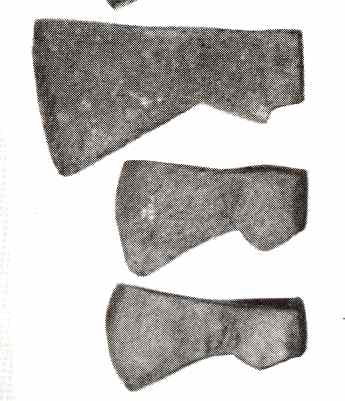
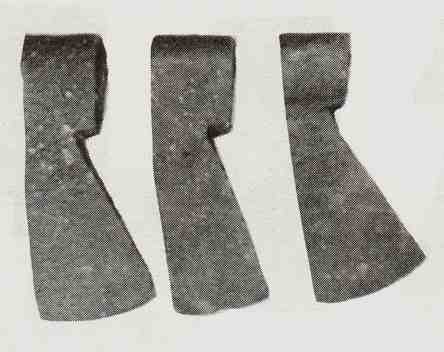
Most people stick a ‘hawk with the handle at an angle of about 45º to the surface of the block. If the upper corner of the edge forms an acute point with the top of the head, the 'hawk will penetrate deeper, and is less likely to fall out. If the point of the edge is above the line of the top of the handle, the axe will still stick if over rotated so the handle forms more of a right angle to the surface of the block. If the edge of the hawk is curved rather than straight, it will be more likely to stick if under rotated so the handle and the edge are parallel to the block.
Using these criteria, the French Lady ‘Hawk and Viking Belt Axe should be excellent throwing axes, and this is in fact the case. Several of the others are not far behind however. The Octagon is very close, and is actually more popular with the black powder folks. The Apachie is just a bit lighter, and throws very well for smaller folks who find 16 ounces too heavy for comfort. Again, these are fine differences, and not hard and fast rules. I’m told the Viking Bearded Axe throws very well by those who have purchased one, and it does not closely follow the above guidelines.
When sharpening an axe for throwing I like to leave the fine grooves from a medium grinding belt on the bevel. I try to orient them so they will be more or less parallel the surface of the block when the handle is at a 45 degree angle. This helps to keep the blade in the block on a marginal throw. This will be standard on the Allan 'hawks unless you tell me you want a polished bevel.
If you need to resharpen your axe you will probably want to use a file and a stone. I use a belt grinder because I have one. I don't know that I'd buy one for the purpose. Unless you have other uses for a sander or grinder, a good file should work just fine. I say "good file" because files are much more fragile then they look, and most are abused. It's best to start with a new one, preferably single cut (with teeth running only one way rather than "criss-cross"). This style leaves a cleaner surface and less of a burr. Keep the teeth clear of chips. Chips will gouge the surface and may cause the file to skate on the edge. USE A GUARD ON THE FILE. If the file does lose bite and skate, it can cause you to drive your hand onto the edge. Apply the file to the metal only on the forward stroke. Lift it off for the return. If you press on the return you will break or bend the teeth and destroy the file very quickly. File with a rocking motion to form a convex edge. A good file will leave very little burr, and you can easily clean this up with a stone. When you are done, wrap your file in paper, or store it in a rack, so the teeth don't rattle against other tools. The teeth on a file are very brittle and break easily. A new file with sharp teeth will just cut the hardened steel of even heat treated axes and blades. A dull one will slide. Here's an excellent article on axe sharpening.
If you throw 'hawks, eventually you break handles. As you get better, you break them less often. Of course if you play "split the handle" with your friends, you'll break a lot more handles. Fitting a new handle should be fairly easy with the correct replacement. Ideally, the new handle should go in easily and snug up an inch or so from position. A couple of firm strikes from a fairly heavy hammer should be all you need. (A heavy hammer tends to move the new handle into position with less damage.) This only works if the head is supported by a stout vise. If you don't have a stout vise you might as well use a medium hammer.
However, this isn't an ideal world and you will probably have to do some fitting. If your new handle won't go in far enough, tap it in lightly, then back out. The tight spots will leave marks on the wood. Remove the marks with a wood rasp, knife, sandpaper, or whatever tool you prefer, and repeat until the handle is close to position. Then seat it firmly.
I've had some questions on how to remove a broken handle. I'd first try sawing it off a couple of inches below the head to provide a solid surface for pounding, then drive it out. It's tapered, so once it's started the rest should be easy. If it's broken close to the head, saw it off and try driving it with something having a flat end. If that fails, try drilling several holes from the top, then pound out the pieces. If all else fails, you can burn it out. If the axe has been heat treated you must keep the edge cool while you are doing this. I've never had to resort to burning out a broken handle, but I've seen it suggested in some old books. I suppose if you are in the woods without access to tools it could be a last resort.
A word about targets: My favorite target is the end grain of a section of softwood log. I like them as large as I can conveniently handle, but at least 18” in diameter and about the same length. Two or three feet is a lot better. Willow or poplar is best, but any soft wood will work nicely. A harder wood requires a stronger throw to stick. I just bore three 2” holes in the side and use sections of saplings or branches as legs. That way if I break one of the legs it’s easy to replace. I can also remove the legs if I want to transport the target. I set them about chest height.
If you don’t have ready access to sections of large log, you can often get one from a local tree service. If you cut your own it’s often free. If they have to cut it for you there may be nominal charge.
An excellent primer was written back in 1909 by Dan Beard, one of the founders of what later became the Boy Scout Movement.
Index
** As you will notice, There is no longer pricing for these on this website, Information only, Please visit https://ragweedforgestore.com/collections/allan For Purchases and New models**
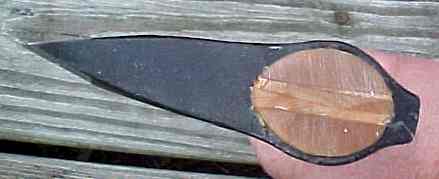
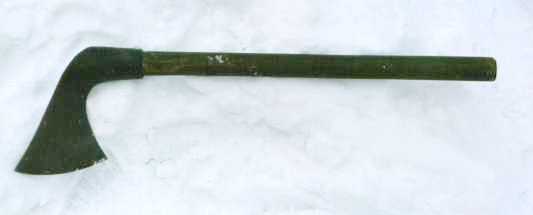
A-23R; The French Lady 'Hawk is pattered after a very old style of throwing axe called a francisca. The Gauls gave Caesar a rather hard time with axes much like these. The pattern was in use over a very long period, and examples have been found as late as the American Colonial period. The head weighs 16 ounces, and has a 4" cutting edge. The increased upsweep improves sticking. This is the most popular axe I sell with the local SCA folks. I throw this one quite a lot myself. It comes with an 18" handle of American hardwood. While it's not evident from the picture, the tapered handle is inserted from the top in the same fashion as the other 'hawks.
The replacement handle is the "OS" style listed below.
Click on the image for a larger picture.

A-23J; Another version of the French throwing hawk. This one is a bit heavier. The head of the basic French 'hawk weighs 20 ounces and has a 4" cutting edge, making it suitable for any competition. It comes with an 18" handle.
The replacement handle is the "TD" style listed below.
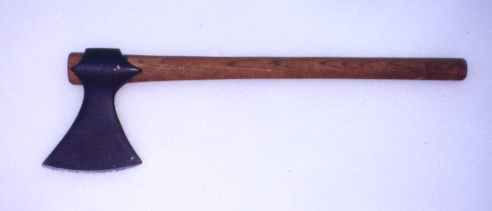
A-23G; The Viking Belt Axe is typical of the all purpose fighting and utility axe of the Viking period. It has the pronounced "ears" flanking the handle that were common on Viking axes. The blade has a pronounced upsweep for good throwing capability. There's a flat on the back for pounding wooden tent stakes, but I don't think it's solid enough for steel stakes. I plan to give one of these a trial as a general camp axe as well as a throwing 'hawk. The head weighs 15 1/2 ounces. The 4 1/2" edge bars this one from NMLRA throwing competition, but is not usually a problem in the SCA. It takes the TD replacement handle listed below.
The replacement handle is the "TD" style listed below.
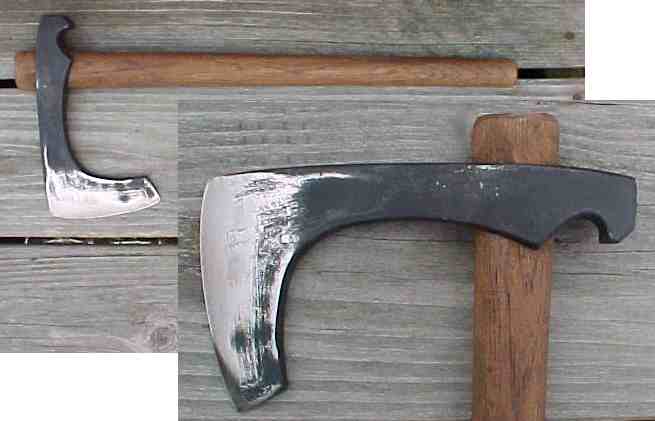
A-23V; The Viking Bearded Axe is a close copy of one found in Gotland. It's just a bit heavier than the belt axe, with a head weight of about 18 ounces. The cutting edge is about 4 1/4". This style was widely found, and could be used as either a tool or a weapon. When used on a long shaft the beard was handy for hooking the edge of enemy shields. It comes with an 18" handle.
The replacement handle is the "TD" style listed below.
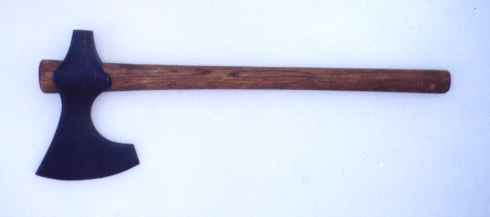
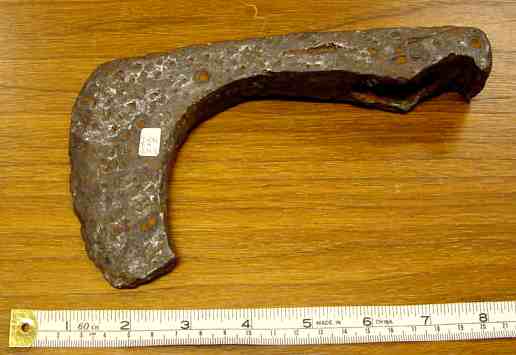
A-23L; The Viking ship builder's axe. The head weighs a full 27 ounces and is in the "bearded axe" style. This allows the user to get his hand behind the edge for shaving strokes. There is a pronounced hammer poll for driving nails, peening rivets, etc. The cutting edge is 4 3/4". It comes with an 18" hardwood handle.
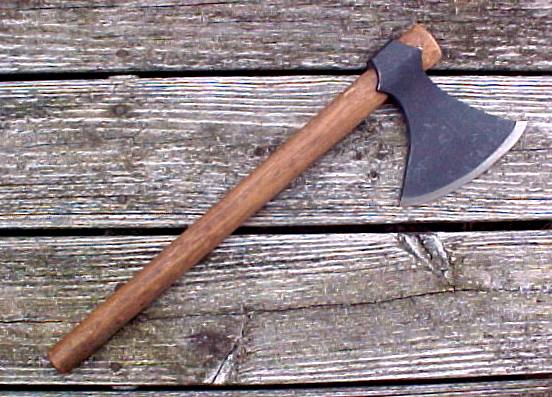
A-23X; The Norse War Axe. This is a big hand axe. The head is about 6" tall, as well as wide. It weighs about 25 ounces. The cutting edge is subtly canted toward the handle. This improves the effective balance for chopping. It comes with an 18" hardwood handle.
The replacement handle is the "TD" style listed below.

A-23B; the Octagon 'hawk is in the style of a better quality frontier 'hawk. It has nicely finished panels reminiscent of "white work", the term for blacksmith work that was finished with a file to remove the forge scale and produce a smooth surface. The cutting edge is about 3 3/4", and the head weighs about 14 ounces. Pete Allan tells me this is the most popular 'hawk among the blackpowder shooters. I can see why.
The replacement handle is the "A-TD" style listed below.
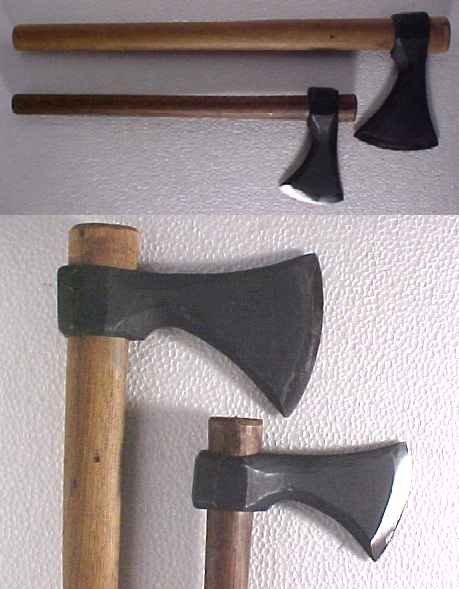
A-23E; the Child's 'hawk is a nicely proportioned 3/4 version of the Octagon 'hawk. This isn't really limited to children. It would make a nice 'hawk for the back of your shooting bag, and is just enough to split some light kindling or help quarter a deer. The 9 ounce head has a bit less than 3" of cutting edge. It comes with a 14" handle
The replacement handle is the "A-TDC" style listed below.
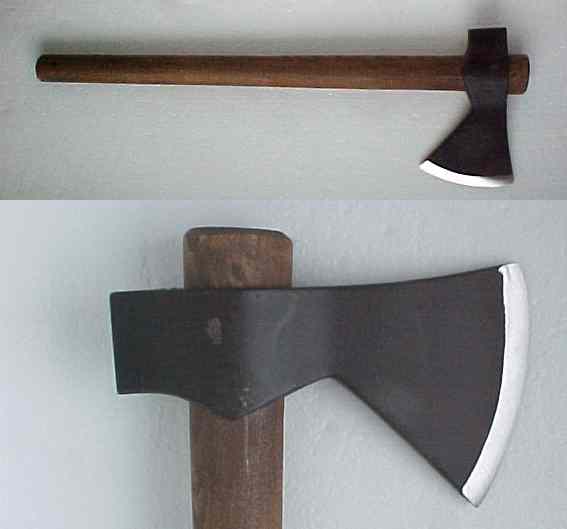
A-23C; The British Belt Axe is very similar to those issued to British troops during the American Revolution. The pattern was used by both sides, and examples have been found in the camps of both Brittish and American forces. The head weighs about 16 ounces and has a 3 1/2" cutting edge. It has a pronounced poll, which was coming into favor at this time. (A poll is the thickened part of the head opposite the edge. It helps to counter balance the weight of the blade, and strengthens the back of the head for pounding.) The axes comes with a 18" handle
The replacement handle is the "A-TD" style listed below.
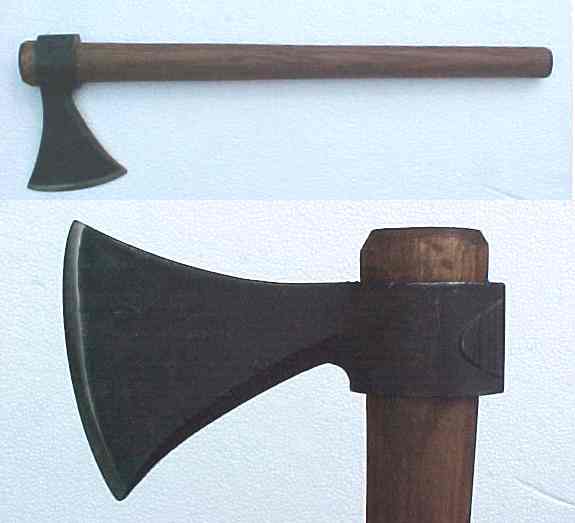
A-23K; the "Apache" mimics the contoured surfaces of the better fileworked 'hawks. The cutting edge is about 3 1/2", and the head weighs about 12 ounces. It feels really good in the hand, and is popular with ladies and others who prefer a lighter 'hawk.
The replacement handle is the "A-TD" style listed below.

A-23o; the "Iroquois" is still fancier, with period style engraving cast into the head, along with file work. It has a flat, thin blade with a 3 1/2" cutting edge. The head weighs about 14 ounces. This is a very dressy 'hawk. It takes the OS replacement handle listed below.
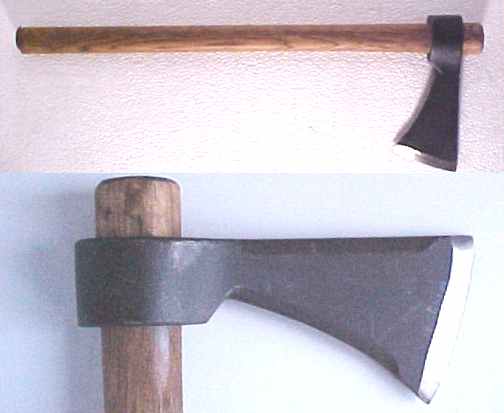
A-23S; The Woodland 'hawk has the narrow blade favored by the Eastern Woodland tribes of North America. This increases penetration and makes it an excellent thrower, as well as a deadly weapon. The shape of the head at the eyes shows some French influence. The pattern is very old, and it wouldn't be out of place for earlier time periods as well. The head weighs about 12 ounces and has a 2 3/4" cutting edge. It comes with a 18" handle
The replacement handle is the "A-OS" style listed below.
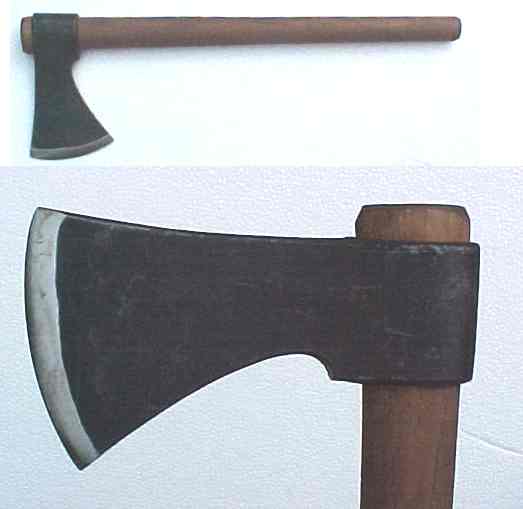
A-23A; the "Old Reliable" is a basic frontier 'hawk with some French trade influence. The cutting edge is about 3 1/2", and the head weighs about 14 3/4 ounces.
The replacement handle is the "A-TD" style listed below.
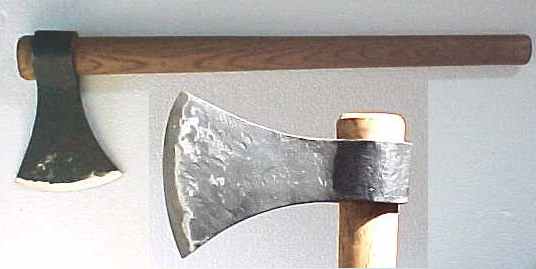
A-23I; The "Hand Forged" 'hawk is not really hand forged, but is modeled on one that is, just for the look. The head weighs about 15 ounces and has a 4" cutting edge. This one is nice for folks who like the hand forged look, but want the consistency of castings for matched sets. It comes with a 18" handle
The replacement handle is the "A-TD" style listed below.
Replacement 'hawk handles A-TD, 18" hickory or ash (no choice), for the Viking Bearded, Viking Belt axe, Viking Shipbuilder's, British Belt axe, Octagon, "Hand Forged", etc.,
A-TD-OVERSIZE: I have a few handles that are considerably oversized. You will have to sand them down to fit. If you want to fool with it, they are $3.00 each.
While all the heads that take the teardrop handle are supposed to be the same, there is some variation among the models. It would be helpful you would specifiy which head you have. For example, the Viking Belt Axe has a slightly larger eye than the Octagon, which in turn is very slightly larger than the British Belt Axe. I'll try to fit them as closely as possible, but as mentioned above, some fine tuning is often required.
A-OS, 18" hickory or ash (no choice), for the Lady French, Iroquois, and Woodland 'hawks,
A-TDC, 14", for the Child's Octagon axe,
A-FM, 14", for the Fort Meigs,
S-SPH, 19" handle for a 'hawk I no longer carry. It's larger than the others. The large end is about 1 3/4" by 1 1/4".
Knife and Tomahawk Throwing, by Harry K. McEvoy. Mr. McEvoy is the founder of the American Knife Throwers Alliance and the author of numerous books, articles and training manuals. This is his introduction to the sport of knife and tomahawk throwing. The little pamphlet is only 28 pages long, but covers the selection of throwing knives, stances and grips, how to build a target, tips on accuracy, and even a brief section on hunting. Out of Stock
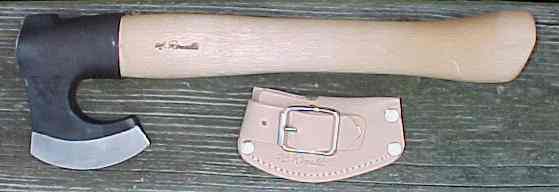
#R860; The Roselli Hatchet is a modern multi-task tool. Besides functioning in the usual way as a chopping tool, the thick wedge shape of the blade makes it unusually efficient for splitting with minimal chance of the blade getting caught in the wood. The cut out in the blade, combined with the rounded form of the head behind the cutout, make it easy to get your hand behind the edge for shaving and carving. It can also be used to skin and dismember large game. The stout edge is better able to stand up to bone and cartilage than the usual thinner edge. I would expect this comes at some cost in chopping efficiency, but most users seem pleased with the performance. There is even a small hammer face on the back for pounding nails or tent pegs. The handle is about 14" long and the cutting edge is about 3 1/2". It's supplied with a stout leather belt sheath. The whole outfit is quite light with a sample weighing about 1 pound, 12 ounces including the sheath.
A replacement sheath is available for
A replacement handle is available for

#R850; The Roselli Axe is the same head mounted on an 18" handle. The extra length increases leverage, gives the option if using both hands for increased power. Interestingly, two samples I tested weighed the same 1 pound, 12 ounces as the shorter hatchet. I suppose there was a difference in wood density.
A replacement sheath is available
A replacement handle is available
Please Click on the Credit Card Symbol Below for the order form